
Paul Epee, Ross Wise, Fang Gou, Yuichi Ando, Sarah Rowley Adams, Braden Crosby (Bragato Research Institute)
The Next Generation Viticulture programme (NGV) aims to improve vineyard profitability by adopting innovative, efficient canopy systems that reduce costs and yield variability, enhance sustainability, and safeguard or enhance the premium wine quality for which New Zealand is renowned. The NGV programme entered its first growing season in September 2024, following the establishment of a network of trials across seven vineyard blocks in the Marlborough region the year prior. The trials are evaluating new canopy training systems for their potential to reduce the time and cost of vineyard operations (pruning, trimming, leaf plucking, trellis work), to improve yield performance and consistency, and to build resilience to stresses (pathogens, water and nutrient availability) while maintaining grape and wine quality.
In the programme, three alternative training systems are being investigated in addition to the standard training system (Figure 1): six vertical cordons with 1.8 m vine spacing (6V), nine vertical cordons with 2.7 m vine spacing (9V), and 12 vertical cordons with 3.6 m vine spacing (12V). These are compared with the control, the commercial-standard training system at the vineyard site. The control is either 2-cane, 3-cane, or 4-cane-trained vines with 1.8 m vine spacing. The number of sites and their locations were selected to account for variability in meso-climate, soil type, grape varieties, and management approaches across the region. Most sites are planted with Sauvignon blanc.
This article summarises key results from the 2024-25 growing season across the seven NGV conversion trial sites. However, for simplicity, only the data from two sites are presented: the Indevin Toi Downs site, referred to as Awatere, and the Paul’s Road Whitehaven site, referred to as Rapaura, both planted in Sauvignon blanc. The article presents results covering pre-veraison vegetative growth, berry maturity, yield and vine balance. A subsequent article will consider winemaking and wine sensory results.
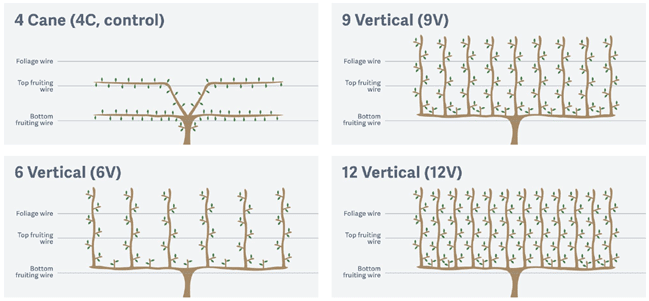 Figure 1: the alternative training systems
The new training systems encouraged early-season canopy development and moderated vigour
The NGV training systems (6V, 9V, and 12V) retained more nodes per vine during pruning, increasing both the number and distribution of fruiting shoots on the vine. As an example, when the control was 4-cane, the average number of retained nodes per vine increased by factors of 2, 3, and 4 for the 6V, 9V, and 12V treatments, respectively. When the control was 2-cane, such as the Rapaura site, these factors were even higher. Across most sites, 6V vines developed their leaf area relatively faster post-budburst until mid-December (Figure 2). These vines carried more shoots per meter of row and had a greater total leaf area (Table 1). This translated into a greater potential to intercept sunlight during the early stages of the growing season.
Shoot morphology and vigour were significantly affected by the training system (Table 1). Shoots of 6V vines were shorter with smaller and fewer leaves (main and lateral leaves) than control vines. Lateral shoots are the hallmark of vigorous growth, resulting in dense canopies and increasing the need for trimming, topping and leaf plucking. Despite carrying over twice as many shoots as the control, 6V had a similar number of leaf layers. At most sites, 6V vines had slightly higher exposed leaf area and total leaf area (Table 1), suggesting a potential advantage in photosynthetic yield and net carbon gain per vine. The structure of 9V and 12V treatments is still in a development phase; once these vines are fully developed, we will test the hypothesis that they will have lower vigour and lower canopy density than the control and 6V vines.
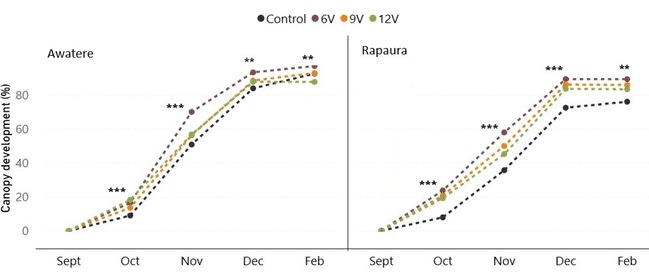
Figure 2: Canopy development over time from budburst through to veraison. The star symbol (*) denotes significant differences between treatments for that month, and the more stars, the more significant the difference with the one-way ANOVA at P <0.05.
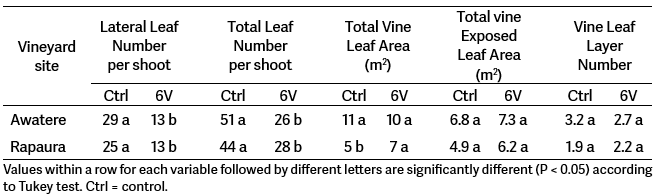 Table 1: Shoot vigour and vine leaf area at veraison
Sugar accumulation was not compromised in one of the three new training systems
Relative to the control, vineyard yield (t/ha) ranged from 16 to 62% higher on 6V, 35 to 55% higher on 9V and 32 to 65% higher on 12V (Figure 3). The main driver of yield was bunch number, with NGV vines carrying more bunches per vine and per meter of row. Control vines had the highest average bunch mass, berry number per bunch and single berry mass. The shift from smaller to larger vines impacted the bunch morphology.
Sugar (total soluble solids – TSS) accumulation was fastest on control vines, slowest on 9V and 12V and intermediate on 6V vines (Table 2). As vine size and yield increased (Figure 3), the accumulation of sugar slowed, with the ripening delay being the shortest at the Rapaura site (Table 2). When both control and 6V were harvested the same day as at the Rapaura site, the difference in sugar concentration was less than one °Brix (Figure 3). At the Awatere site, 6V and control were harvested 12 days apart, achieving similar sugar levels.
The rate of decrease in titratable acidity (TA) was similar across all four treatments within the same site. pH levels increased more slowly with increasing vine size at the Awatere site, whereas at the Rapaura site, the increase in pH was similar across vine sizes (Table 2).
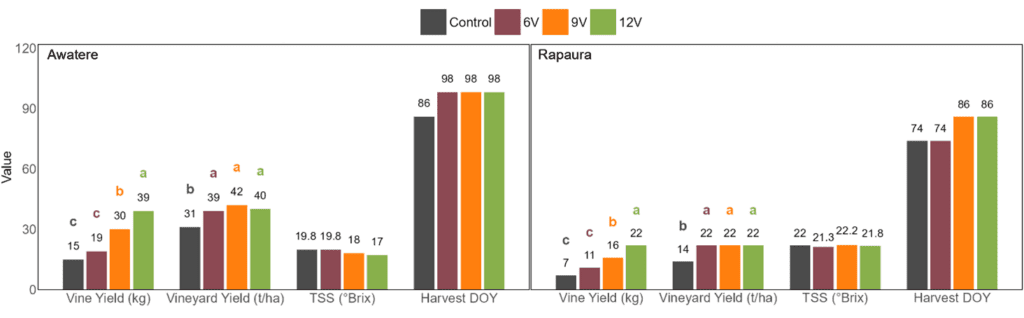
Figure 3: Yield, harvest DOY (day of year) and pressed grape juice TSS (total soluble solids). For each site and variable, identical letters indicate no significant difference according to one-way ANOVA followed by Tukey’s test (P < 0.05). The variables “Harvest DOY” and “TSS” were not analysed for statistical significance; thus, no significance letters are present.
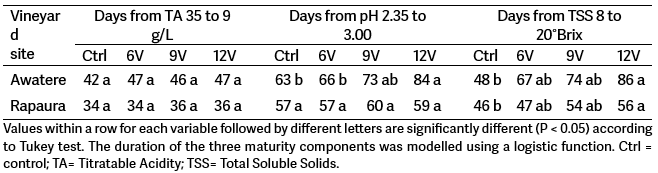 Table 2: Duration of berry maturity
Vines can ripen the same quantity of grapes with less leaf area than they currently do on cane-pruned vines
At dormancy, the canes of control vines were the most vigorous; they were longer, had a greater number of nodes, and were thickest. Vine vigour (defined as the total annual wood or total cane mass produced) varied greatly between treatments and sites. At most sites, 6V and control had similar vine vigour. At the Rapaura site, the vigour was comparable across all four treatments. Control vines had the greatest amount of dormant wood removed through pruning, over 90%, compared to about 50% for NGV treatments. The pruned wood represents a significant loss of carbohydrate reserves, which are essential for driving early spring shoot growth.
The source-sink ratios (Exposed Leaf Area to fruit mass ratio – ELA/FM, and Total Leaf Area to Fruit Mass ratio – TLA/FM) were highest on control vines (Table 3). Those vines ripened their fruit faster. However, at the Rapaura site, despite a slightly lower ELA/FM, 6V vines ripened fruit with sugar concentration similar to that of the control. All treatments with ELA/FM below 0.6 m2/kg required more days to ripen the fruit to a minimum soluble solids concentration of 20°Brix, and in some cases, that minimum was not reached. It must be emphasised that the crop level this season was exceptionally high, and it was decided not to crop thin to let the vines express their full potential. As a result, the accumulation of soluble solids was slower in treatments and sites with heavier crops. This relationship will be explored further in the coming seasons.
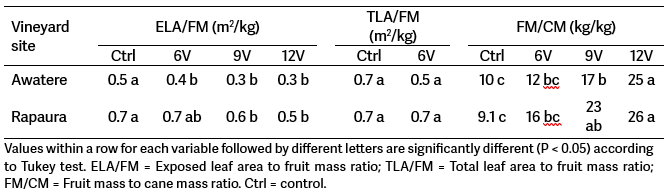 Table 3: Vine balance ratios
Key takeaways of the 2024-25 viticulture results
The new training systems (6V, 9V and 12V) grew significantly more shoots and developed their canopies faster than the control early in the season. At veraison, the vigour of 6V shoots was moderate, as they were shorter in length, with fewer lateral shoots and smaller leaves. 6V vines had relatively lighter bunches with fewer, smaller berries. Other reproductive variables, such as flower number, flower abortion rate, and fruit-set, were generally unaffected by the increase in vine size.
Sugar accumulation was generally faster on control vines; however, the ripening delay was only a few days, and rarely over two weeks for 6V vines. The time for TA to decline and for pH to rise to the target levels was generally similar across treatments. The new training systems produced higher yields and achieved target ripeness at most sites. Vine vigour (annual vegetative biomass) was comparable between 6V and control vines at most sites. A source-sink ratio above 0.6 m2/kg was required to achieve a soluble solids concentration of 20°Brix. The new training systems encouraged higher biomass retention at pruning compared to control vines, increasing their potential to store carbohydrate reserves.
A critical goal of NGV is to design a training system that naturally manages excess vine vigour and, in doing so, reduces the number of canopy-management operations, such as trimming, leaf plucking, wire lifting and pruning, improving vineyard profitability and sustainability. Early signs of vigour control are already perceptible on 6V vines. As the other new training systems (9V and 12V) develop, grape and wine composition will be closely monitored to ensure quality is not compromised. These aspects will be discussed in the next article.
![If present, [Name] wears black gloves and holds two bunches of green grapes outside amid blurred greenery and sunlight.](https://bri.co.nz/wp-content/uploads/2026/03/BRI-NGV-Mar26_RBPHOTO-58-1024x576.jpg) NGV bunch (left) compared to control bunch size (right)
NGV bunch (left) compared to control bunch size (right)