


New Zealand Sauvignon Blanc is an export success story, with the wine style loved around the world. Due to our distance from our export markets at the bottom of the Pacific, shipping unpackaged wine and bottling in the destination market has become mainstream in little more than a decade. Recent industry data shows that since 2024, a greater volume of New Zealand wine has been exported in bulk format than bottled at source.
However, New Zealand aromatic wines such as Sauvignon Blanc rely on fragile volatile compounds that are sensitive to oxygen exposure and temperature variation. As bulk shipping volumes continue to increase, the industry’s challenge is not whether bulk shipping can work, but how it can be managed consistently and predictably so that wines land in the market in the same condition they left the winery.
BRI has recently undertaken a literature review to consolidate current knowledge on the preservation of quality and style when shipping unpackaged wines in bulk, provide recommendations for best practices where appropriate, and identify knowledge gaps for further research. This article summarises the findings.
What is bulk shipping?
Bulk shipping is the physical movement of unbottled wine between origin and destination using specialised containers designed for liquid cargo transport. The defining feature is that the wine is shipped in large liquid volumes rather than consumer-ready units, such as bottles.
Two container types dominate bulk wine transport: ISO tanks and flexitanks. ISO tanks are reusable stainless‑steel vessels offering excellent inertness and very low oxygen transmission, but they require cleaning and repositioning, which can limit availability and increase cost.
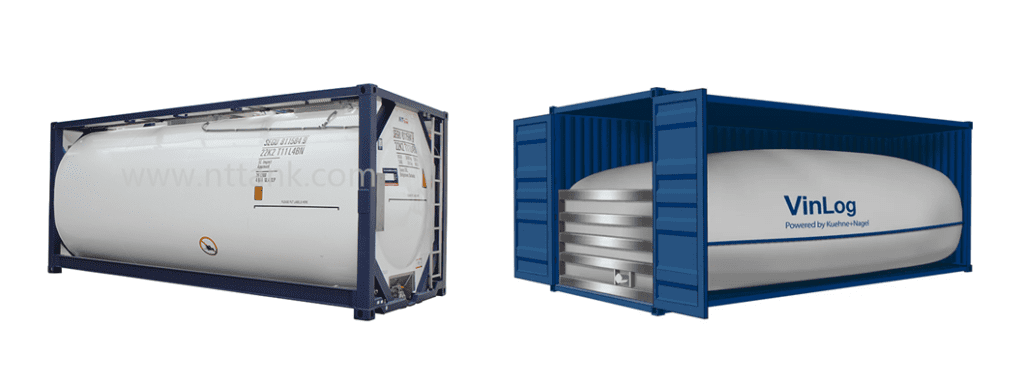 Image: ISO Tank (left) and Flexitank (right).
Flexitanks are single‑use polymer bladders fitted inside standard shipping containers and are now the most common option for wine. Modern flexitanks incorporating EVOH barrier layers have dramatically improved oxygen performance compared with earlier designs and have become a viable option even for sensitive white wines, provided specifications are understood and respected.
Who uses bulk shipping?
The New Zealand wine industry comprises a wide range of producers, from large corporate organisations to smaller boutique producers, with varying approaches to export logistics and bulk shipping adoption. Preference for bottled versus bulk shipping is not consistently correlated with the size of the producer and is more likely to be informed by their preference for maintaining control over the wine being transported under their brand name.
Once wine leaves the winery in a tank or flexitank, responsibility for its handling and final presentation is shared with logistics providers and bottlers overseas. For many producers, particularly smaller wineries, the perceived loss of oversight can feel uncomfortable.
At the same time, other exporting countries such as Australia and South Africa have successfully implemented large-scale bulk shipping programs, demonstrating the commercial viability of the model and creating competitive pressure for New Zealand producers.
The benefits: emissions reductions and flexibility
Packaging is the most significant contributor to winery greenhouse gas emissions. Shipping wine in bulk can significantly reduce the carbon footprint per litre by eliminating glass weight and associated transport, as well as reducing costs. However, Flexitanks and ISO tanks each carry their own sustainability considerations, from recyclability to repositioning requirements. Expanding system boundaries to capture emissions beyond the winery gate will be essential if the industry is to make informed comparisons between shipping options.
Shipping bulk volume instead of finished product also separates production decisions from final market packaging. This flexibility is increasingly valuable in volatile markets where products may need to be redirected, blended, or bottled under different labels depending on demand. Export markets such as the United States and the United Kingdom now have sophisticated bulk‑receiving and bottling infrastructure, making in‑market bottling an established part of the supply chain rather than a risk‑laden experiment.
The risks: oxidation and temperature
Oxidation remains the single greatest technical risk identified across the literature. Oxygen exposure during filling, through headspace, or via slow ingress over time consumes free sulphur dioxide and drives colour changes, aroma loss and premature ageing. Best practice in bulk shipping mirrors best practice at bottling: wines should be microbiologically stable, transferred with minimal turbulence, filled at moderate temperatures and handled under inert gas wherever possible. Measuring and managing dissolved oxygen close to the date of dispatch is critical, not only to minimise risk but to provide data that can be reviewed against arrival analyses in the market.
The concept of total package oxygen, well established in bottled wine, is increasingly useful for bulk shipments. By considering both dissolved oxygen at loading and the oxygen transmission rate of the chosen vessel, winemakers can make informed decisions about protective additions and anticipate changes during transit. While there is no single predictive model suitable for all wines, understanding oxygen exposure in quantitative terms is far more effective than relying on generic sulphur dioxide targets.
Temperature is the second major risk factor. Extended exposure to temperatures above 25 °C, or short spikes above 40 °C, is known to accelerate chemical reactions that damage wine quality and reduce the effectiveness of antioxidants. Bulk shipments benefit from greater thermal inertia than bottled wine, which helps buffer short‑term fluctuations, but they are not immune to heat stress. Shipping routes from New Zealand typically cross the equator and often involve port stops or trans‑shipping hubs where containers can be exposed to significant ambient heat.
Options for temperature management range from refrigerated containers to insulated liners and strategic routing choices. While full refrigeration adds cost and emissions, insulating liners and careful booking practices can offer meaningful protection at a more moderate price point. Research also shows that most extreme temperature fluctuations occur during land transport rather than at sea, highlighting the importance of end‑to‑end logistics planning rather than focusing solely on the ocean leg.
Other considerations for wineries using bulk shipping
Sulphur dioxide management during bulk transport requires particular attention. Free SO₂ levels consistently decline during shipping as oxygen is absorbed and bound. The rate of this decline varies widely depending on wine chemistry, vessel choice, temperature and duration of transit. There is currently no New Zealand‑specific model to predict sulphur dioxide loss in bulk shipments, reinforcing the importance of conservative setpoints at dispatch and follow‑up analysis on arrival. The aim is not to maximise additions, but to ensure that wines arrive with sufficient protective capacity to be safely handled and bottled.
Other additives may have a role under specific circumstances. Ascorbic acid can provide additional oxidative protection for white wines when oxygen exposure is very low, but it must be used cautiously and always in conjunction with adequate sulphur dioxide. Dimethyl dicarbonate is widely used as a microbial control aid for bulk shipments, particularly for wines containing residual sugar, while potassium sorbate may be appropriate for certain styles if microbial risks are well understood and managed. Across all cases, prevention of instability before shipping is more reliable than correction after arrival.
Residual sugar, filtration status and redox balance all interact during bulk transport. Wines with elevated residual sugar carry a higher risk of refermentation and microbial spoilage, particularly if temperature control is inadequate. For this reason, sterile filtration at loading is widely regarded as standard risk management practice for bulk wines, even if it would not otherwise be applied to the same wine bottled at source. Shipping unfiltered wine in bulk remains poorly documented and is generally regarded as high risk.
One of the most prominent findings is how uneven the evidence base remains. Much of what we know about temperature effects, oxidation and closure performance comes from studies on bottled wine rather than bulk vessels. Research directly examining New Zealand wines shipped in modern flexitanks or ISO tanks is limited, particularly for Sauvignon Blanc. Emerging topics such as microplastic contamination, redox evolution in bulk formats and comparative performance between flexitank suppliers are also under‑researched.
In summary
For winemakers navigating today’s export landscape, bulk shipping can preserve wine quality very effectively, even for aromatic styles, when oxygen, temperature, microbiology and logistics are managed with intent. The knowledge gaps lie not in basic understanding, but in the lack of New Zealand‑specific data that would allow producers to move from risk management to prediction.
A coordinated research effort tracking wines shipped in bulk and bottle side by side, across different routes and seasons, would provide invaluable insights to New Zealand producers. Until then, the best outcomes will continue to come from disciplined process control, close collaboration with logistics and bottling partners, and a willingness to treat bulk shipping as an extension of the winery, not a separate or lesser step in the supply chain.
About the project
This project was funded by the Bragato Research Institute’s contestable funding. It reviewed and consolidated existing literature and resources on bulk wine shipping to identify knowledge gaps and potential directions for further research.