


Grapevine trunk disease (GTD) remains one of the most significant causes of vine decline in New Zealand vineyards. As vineyards age, infections accumulate within the trunk and vascular system, leading to reduced productivity, canopy dieback, vine death, and ultimately loss of vineyard value. For growers managing mature blocks, the question is often not whether GTD is present, but what to do about it.
A multi-year research project initiated through the New Zealand Winegrowers and Bragato Research Institute Vineyard Ecosystems Programme has been investigating whether remedial surgery can provide a viable alternative to vine replacement for managing grapevine trunk disease. The work, undertaken by Drs Eline van Zijll de Jong and Mark Sosnowski and financial analyst Greg McCarthy, integrated commercial vineyard trials, industry surveys, and economic modelling to assess the biological effectiveness and economic viability of remedial surgery.
The latest results provide growing evidence that remedial surgery can slow vine decline, maintain productivity, and improve short-term vineyard returns when applied before disease becomes too advanced.
The evidence is increasingly supporting remedial surgery as an effective and economically viable management option for grapevine trunk disease, particularly when applied before extensive vine decline occurs.
What is remedial surgery?
Remedial surgery involves removing diseased trunk tissue above the graft union and training a new trunk from shoots that emerge at the base of the scion (Figure 1). Unlike vine replacement, the established root system is retained, allowing vines to recover more quickly and at a lower cost.
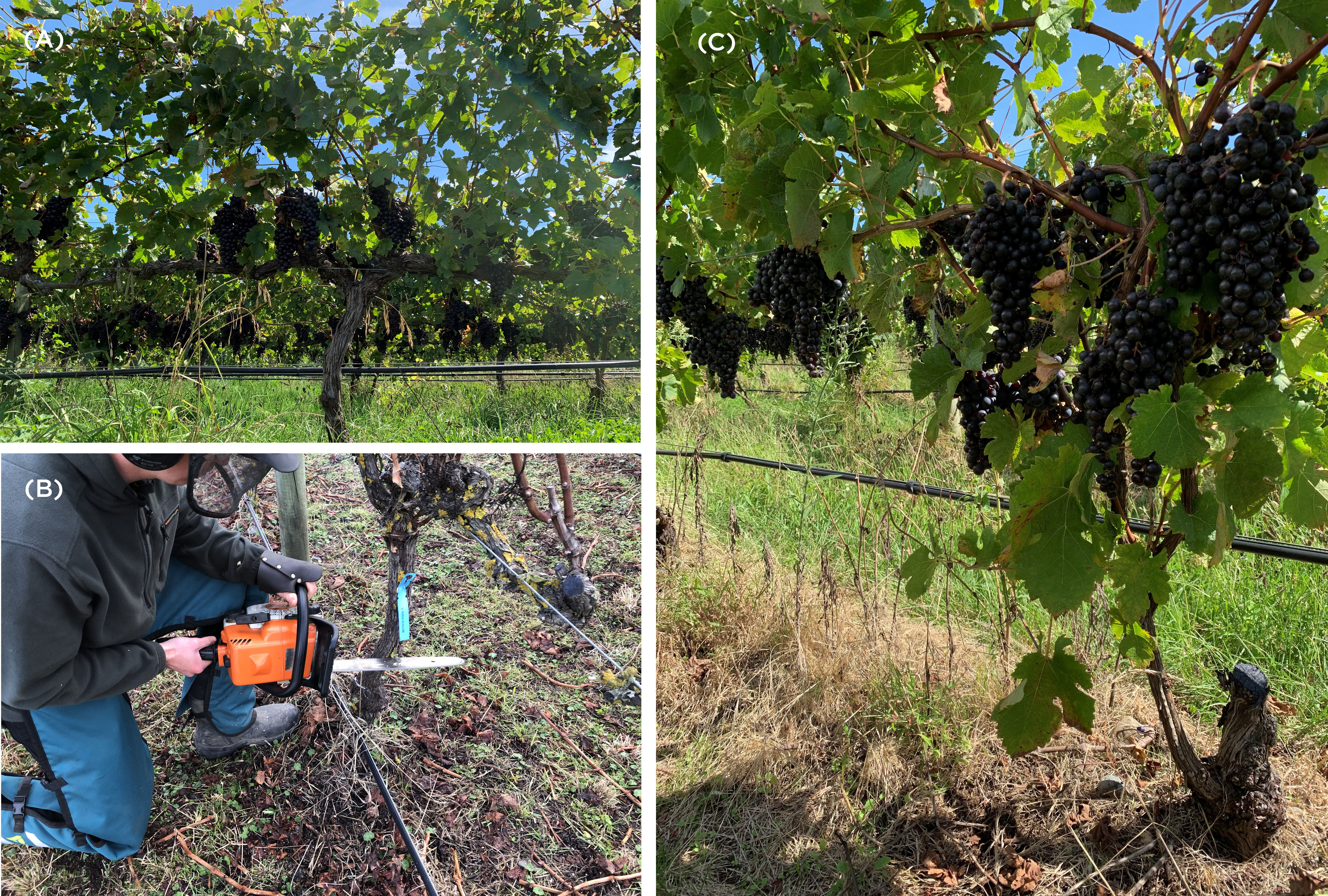
Figure 1. Vines in the Merlot remedial surgery trial in Hawke's Bay. (A) Untreated control vine in 2023. (B) Remedial surgery being performed. (C) Remediated vine in 2023, four years after remedial surgery.
Although the technique has been used in New Zealand and overseas, adoption has been limited by uncertainty around its effectiveness, long-term success, and economic return. Growers have sought answers to practical questions such as:
When should remedial surgery be undertaken?
How much of the trunk should be removed?
Is vine recovery better following spring or winter surgery?
How quickly will yield recover?
How long do remediated vines continue to survive and perform?
Does the investment pay off compared with doing nothing and vineyard replacement?
To help answer these questions, trials were established in 2019 in a commercial Sauvignon Blanc vineyard in Marlborough and a commercial Merlot vineyard in Hawke's Bay. Vines were remediated over five consecutive years, creating a unique opportunity to compare the outcomes of early intervention with those of delayed treatment.
The trials showed that earlier intervention generally leads to better vine recovery. They also confirmed that vines should be cut back as low as possible while retaining healthy scion tissue for regrowth, and that, where the risk of late frost is low, remedial surgery can be undertaken in winter rather than spring, avoiding problems with pruning wound protectant loss caused by spring sap flow. These findings led to further investment in the research to monitor the short-term health, survival, and productivity of remediated vines compared with untreated vines.
Disease progression not evident in remediated vines
Disease continued to worsen in untreated vines at both trial sites.
In the Sauvignon Blanc trial, canopy dieback eventually affected all untreated vines, while disease severity continued to increase over time. The Merlot trial showed slower disease development, but symptoms also increased as vines aged.
In contrast, no canopy dieback symptoms were observed in vines that had undergone remedial surgery, including vines treated up to six years earlier. These results indicate that remedial surgery can effectively suppress disease expression in the short term and restore healthy canopy growth.
Researchers caution that GTD fungi can remain latent within vines for several years, so continued monitoring will be needed to determine how durable these benefits prove to be over the long term.
High survival rates after surgery
Vine survival has also remained encouraging.
In the Sauvignon Blanc trial, survival of remediated vines exceeded 90% over the seven-year monitoring period. Survival in Merlot was even higher, averaging approximately 99%.
Previous assessments have shown that success is strongly influenced by the amount of infected wood present at the time of surgery. Earlier intervention increases the likelihood of removing infected tissue, improving the chances of establishing a healthy replacement trunk.
These findings reinforce a simple message for growers: waiting too long may reduce the effectiveness of remedial surgery.
Productivity benefits already emerging
Remedial surgery restored productivity in Sauvignon Blanc to levels comparable with untreated vines and increased cumulative yields in Merlot (Table 1). In Merlot, the benefits were particularly evident in more challenging growing seasons, when diseased vines were less able to maintain production.

Table 1. Total fruit production of untreated (control) and remediated Sauvignon Blanc and Merlot vines over four vintages following the return of remediated vines to full production in the remedial surgery trials.
These findings demonstrate that remedial surgery can deliver productivity benefits within a relatively short timeframe where grapevine trunk disease is limiting vineyard performance. As the disease continues to progress in untreated vines, the production advantage of remediated vines is likely to increase.
Vineyard surveys confirm GTD remains widespread
Alongside the field trials, researchers surveyed 50 commercial Sauvignon Blanc vineyards in Marlborough and 21 Merlot vineyards in Hawke's Bay.
The surveys confirmed that GTD remains common throughout New Zealand vineyards (Figure 2) and generally becomes more severe as vineyards age.
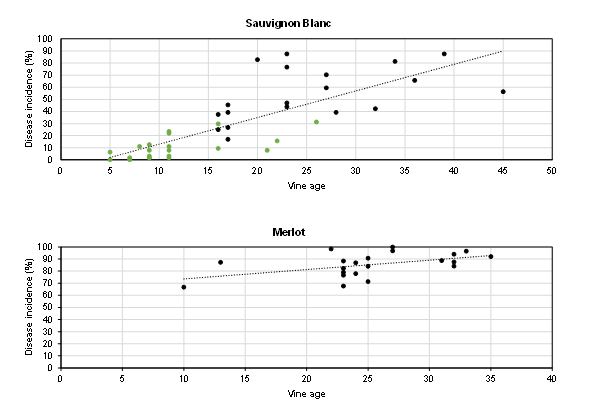
Figure 2. Relationship between vineyard age and canopy dieback incidence in commercial, conventionally managed Sauvignon Blanc (Marlborough) and Merlot (Hawke's Bay) vineyards. In Sauvignon Blanc, green points indicate blocks where pruning wound protection was implemented before vines reached 8 years of age.
One of the clearest findings was the value of pruning wound protection. After accounting for vineyard age, Sauvignon Blanc vineyards that had not adopted early wound protection had substantially higher levels of disease than vineyards where wounds had been protected from an early stage.
The surveys support previous industry recommendations that pruning wound protection should be viewed as a long-term investment in vineyard health. However, wound protection alone does not completely prevent infection, meaning disease can continue to accumulate over time.
As a result, remedial surgery may become an important management option when disease levels begin to impact vine health and productivity.
When does intervention make economic sense?
The project also developed an economic model to compare no intervention to different responses to GTD, including:
Replacement gap filling
Remedial gap filling
Whole-vineyard remedial surgery
Vineyard removal and replanting
The economic model calculated a Net Present Value (NPV) of the estimated revenues and additional costs of each response. This did not include all other vineyard costs, which will mostly be a (vineyard specific) constant across each of the responses considered, but will differ from vineyard to vineyard. The estimated NPV is therefore not an estimated “net profit”, but rather a relative value for each response, for comparative purposes.
Remedial surgery generally outperformed non-intervention once productivity losses became moderate (approximately 14% yield loss; Figure 3).
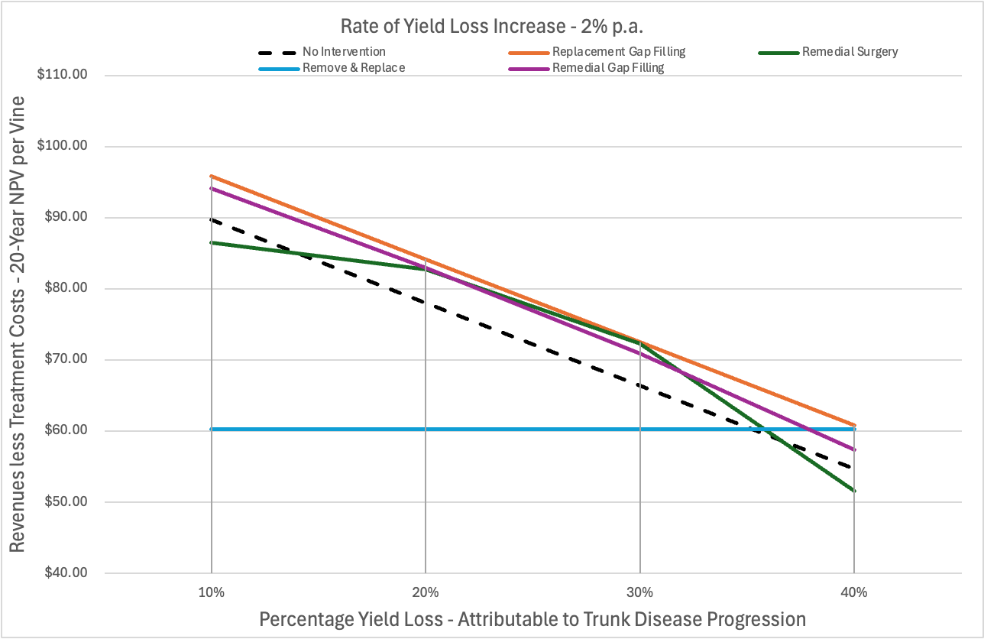
Figure 3. Relative 20-year Net Present Values (NPVs) assuming current yield losses ranging from 10 to 40%, increasing at 2% p.a. All NPV estimates reflect vine survival/treatment success assumptions for each response. Actual vineyard outcomes will vary.
The modelling suggested that remedial surgery can recover its costs relatively quickly and generate stronger long-term returns than simply allowing disease to progress unchecked. Remedial and replacement gap filling also performed well due to having relatively low implementation costs.
Complete vineyard redevelopment only became relatively more attractive when yield losses exceeded approximately 30%, or where the likelihood of successful remediation was low.
The benefits of remedial surgery accrue over extended periods, so comparative analysis on a 10-year economic return resulted in less favourable response decisions for vineyard longevity, namely no intervention.
While these results depend on assumptions about long-term vine survival and treatment success, they provide a practical New Zealand economic framework to help growers assess the costs and benefits of different GTD management strategies.
Looking ahead
Provided the trial sites are retained, continued monitoring over the next 5-10 years will be critical for determining how long the benefits of remedial surgery persist. The extensive data collected on the disease status of individual vines at the time of remediation also provide a unique opportunity to investigate how disease severity at the point of intervention influences long-term outcomes, providing improved decision-support for growers embarking on proactive GTD management.